
.png)
Today, Wasabi customers can take direct action on the carbon footprint associated with their cloud storage. Wasabi Impact Circle, powered by ZeroCircle, is now live within the Wasabi Account Control Manager.
This post explains what it is, how it works, who powers the carbon credit portfolios behind it, and what a Wasabi customer actually receives when they make a purchase.
Wasabi Impact Circle was developed to make climate action as accessible as cloud storage itself. Rather than requiring customers to navigate fragmented carbon markets, identify projects, and manage retirement processes independently, Impact Circle integrates verified carbon credit purchasing directly into the storage management experience.
What Is Wasabi Impact Circle?
Wasabi Impact Circle is a sustainability feature embedded directly inside the Wasabi Account Control Manager — the same dashboard Wasabi customers already use to manage their storage, accounts, and billing.
It does three things. It shows customers their storage-related carbon footprint, calculated from their actual usage data. It lets them choose a carbon credit portfolio to offset that footprint. And it issues a verified Carbon Offset Attestation once the purchase is complete — a document customers can use in sustainability reports, investor communications, and ESG disclosures.
The entire process happens inside Wasabi. No new platform to log into, no new vendor relationship to manage, no procurement cycle to navigate.
How It Works
1. Calculate and Track with Clarity
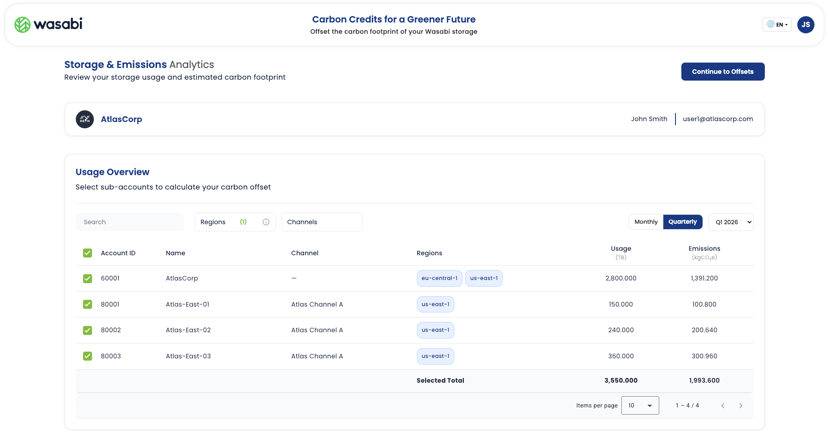
When a customer opens the Impact Circle section of their Wasabi dashboard, they see their total storage-related carbon emissions for a selected period — broken down by subject, manager, region, and channel. The footprint is calculated directly from their actual Wasabi storage usage data, so the number reflects their real footprint rather than a generic industry estimate. Customers can view emissions monthly or quarterly, select the specific subjects they want to offset, and see a running total before proceeding. The dashboard makes it straightforward to understand exactly what you are responsible for and what you are choosing to address.
2. Select a Portfolio
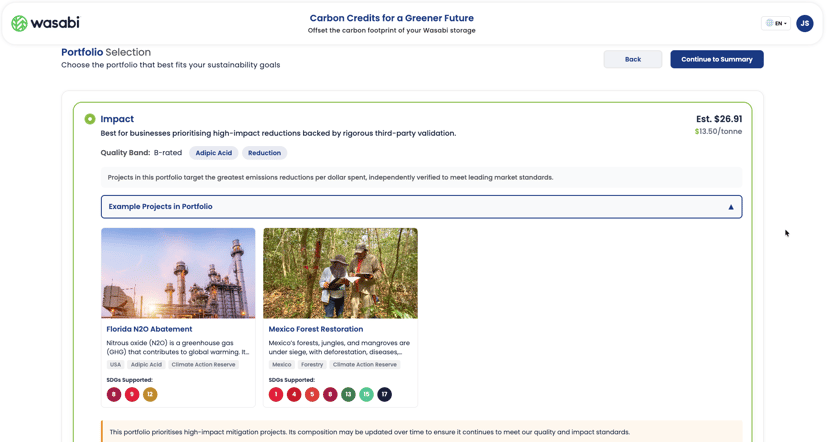
Once a customer has confirmed their emissions selection, they choose a carbon credit portfolio. Each portfolio represents a curated set of verified carbon projects with a distinct profile of project type, quality band, and price per tonne. Customers can expand each portfolio to see example projects — including the project name, country, registry, and the UN Sustainable Development Goals it supports. This transparency is deliberate: customers should know what they are funding, not just receive a generic offset certificate. Four portfolios are available, each described in detail in the section below.
3. Purchase and Report Seamlessly
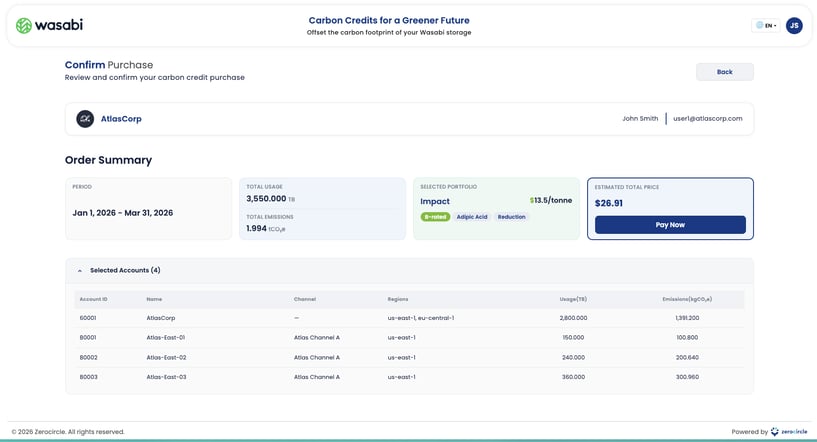
The purchase is completed directly within the Wasabi dashboard — no external platform, no separate login, no new vendor relationship. Once payment is confirmed, the carbon credits are retired on the customer’s behalf through Zero Circle’s fulfilment process. Retirement is permanent: the credits are removed from the market and cannot be resold or reused. A full transaction record appears in the customer’s order history, showing the period covered, the portfolio selected, the quantity retired in tonnes of CO₂e, and the current status. Customers can filter and review their full purchase history at any time.
4. Download Your Carbon Offset Attestation
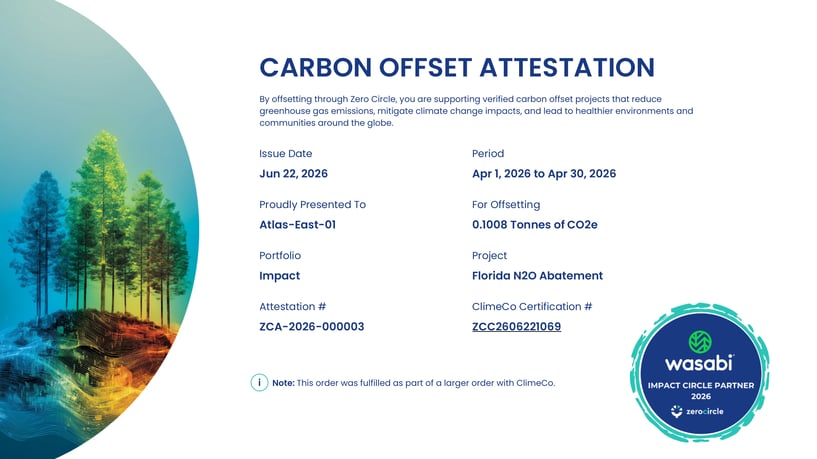
Once processing is complete, ZeroCircle issues a Carbon Offset Attestation for each subject covered by the purchase. This is a formal certificate that can be downloaded directly from the dashboard. It shows the customer’s name, the period covered, the tonnes of CO₂e offset, the portfolio and specific project used, a unique ZeroCircle Attestation number, and a ClimeCo Certification number that traces the credit back to the underlying project registry. This document is designed to be included in annual sustainability reports, ESG disclosures, and investor communications — providing the auditable proof of action that responsible reporting requires.
The Portfolios — Powered in Partnership with ClimeCo
The carbon credit portfolios available through Wasabi Impact Circle are sourced and fulfilled in partnership with ClimeCo, a global sustainability company and one of the leading providers of high-quality environmental credits in North America.
At ZeroCircle, we believe the quality of a carbon credit is everything. Before any project appears in a portfolio, it goes through ZeroCircle's evaluation process — screening for additionality, permanence, verification rigour, and meaningful community benefit. Credits are pooled across multiple projects so that no single project carries all the risk, and every retirement is tracked to avoid double-counting. We curate for quality, not volume. The result is a set of portfolios that a non-expert buyer can act on with the same confidence as an institution running full diligence — without needing to build that infrastructure themselves.
ClimeCo handles the fulfilment, retirement, and certification of credits within each portfolio — generating a unique ClimeCo Certification number that appears on every Carbon Offset Attestation, creating an auditable chain of custody from the customer's dashboard through to the underlying project registry.
The projects cover a range of technologies and geographies — from nitrous oxide abatement and renewable energy in North America to forestry conservation and regenerative agriculture in Mexico and Europe. Each is verified under recognised standards including Verra's Verified Carbon Standard and the Climate Action Reserve.
When a Wasabi customer completes a purchase, they are not buying a commodity offset. They are holding a verified, retired, traceable credit — the kind that holds up under scrutiny.
Below is a breakdown of the five portfolios available through Wasabi Impact Circle — and what makes each one distinct.
Value — Entry | Reduction
Best for businesses seeking an affordable entry point without compromising on credibility.
A practical starting point for businesses looking to offset at scale, sourced from credible registries with established track records. Projects in the Value portfolio prioritise volume and accessibility, offering a straightforward way to begin addressing your storage footprint without a significant cost commitment.
Impact — B-rated | Reduction
Best for businesses prioritising high-impact reductions backed by rigorous third-party validation.
Projects in this portfolio target the greatest emissions reductions per dollar spent, independently verified to meet leading market standards. The Impact portfolio is designed for businesses that want their offsetting to have the strongest possible climate effect, with verification processes that stand up to scrutiny.
Premium — A-rated | Mixed
Best for businesses that want higher-quality credits with a greater focus on carbon removal projects.
Credits with stronger verification and longer-lasting climate impact, suited for businesses with serious net-zero commitments. The Premium portfolio includes a mix of reduction and removal projects, weighted toward those with stronger permanence and higher integrity ratings.
Premium+ — A-rated | Nature-based
Best for businesses that want the highest-integrity credits — rooted in real-world land use change and measurable community benefits.
Projects that combine regenerative land use with verified social and environmental benefits, for businesses that want impact beyond carbon alone. The Premium+ portfolio is the most ambitious tier — suitable for organisations with formal net-zero targets or those whose stakeholders expect the highest standard of climate action.
Frontier — Removal
Best for businesses that want to go beyond offsetting and invest in emerging, high-integrity carbon removal technologies.
The Frontier portfolio represents the next frontier of climate action — engineered carbon removal solutions designed for durable, long-term storage. Projects in this portfolio convert agricultural waste into biochar, which is applied to soil to lock carbon away while improving soil productivity and agricultural resilience. Unlike reduction-focused portfolios, Frontier credits follow a carbon dioxide removal (CDR) pathway, making them suited for organisations with the most ambitious net-zero commitments and a desire to support the scaling of next-generation climate solutions.
Why This Matters
Every file stored in the cloud resides on physical infrastructure powered by electricity. As data volumes continue to grow, organisations are increasingly recognising that digital operations contribute to their overall carbon footprint. Yet unlike travel, fuel, or electricity consumption, emissions associated with data storage often remain invisible to business decision-makers. Most businesses know their energy use generates emissions. Fewer have thought carefully about the footprint of the data they store — even though it runs continuously, in data centres that consume electricity around the clock.
Wasabi Impact Circle makes it straightforward to address that footprint — not by replacing longer-term decarbonisation commitments, but by providing an immediate, verified, and auditable way to compensate for emissions that exist right now.
For Wasabi customers working toward sustainability targets, ESG reporting requirements, or simply wanting to take responsible action on their digital footprint, Impact Circle removes the friction that has historically made carbon offsetting feel complicated or inaccessible.
The entire process happens inside Wasabi. No new platform to log into, no new vendor relationship to manage, no procurement cycle to navigate.
Get Started
Wasabi Impact Circle is available now inside the Wasabi Account Control Manager. If you are a Wasabi customer and want to understand your storage-related carbon footprint and take action on it, log into your dashboard and navigate to Impact Circle to get started.
Want to learn more about how ZeroCircle helps businesses address their digital carbon footprint? Visit us at zerocircle.eco.