
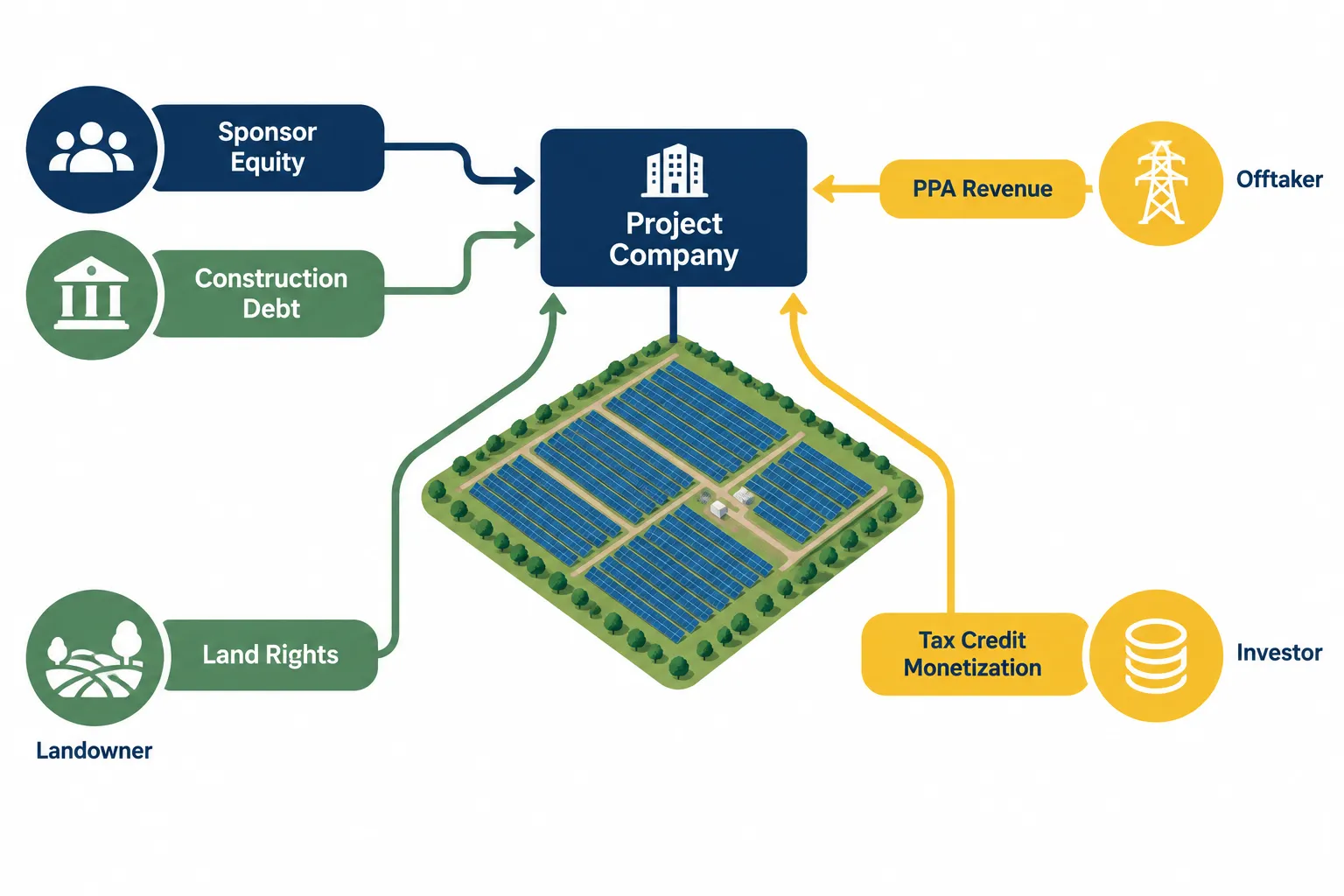
Solar farm financing usually combines sponsor equity, debt and a way to monetize tax benefits. Local solar companies can quote the solar installation and supply solar panels, but they do not by themselves assemble the farm's capital stack. A power purchase agreement (PPA) supports financing by securing revenue; a land lease secures site access. Neither puts cash in the construction account. The right mix depends on ownership, power sales, timing and risk.
Utility-scale developers may need development equity first, then construction debt, tax-credit monetization and a term loan. Corporate hosts must decide whether to own the asset or buy its output from a third-party owner. Landowners can lease acreage to a developer without taking responsibility for financing or operating the plant.
Understand the solar farm capital stack
Developers commonly place the site rights, permits, interconnection rights and key contracts in a special-purpose project company. Investors and lenders can then underwrite a defined asset and its cash flow. Non-recourse project debt relies mainly on project assets and revenues. Lenders may still ask for limited sponsor guarantees during construction.
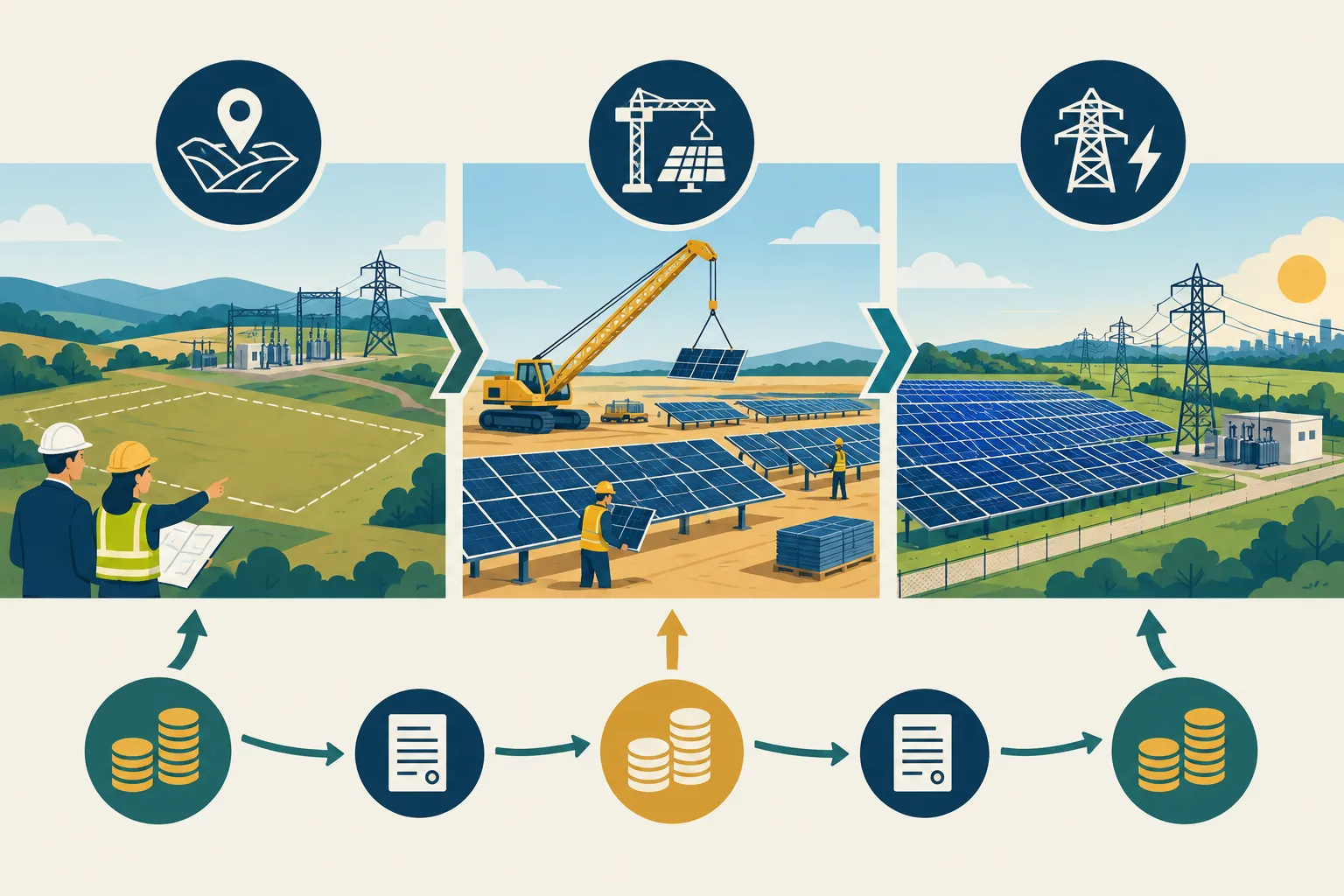
Financing changes with the project stage:
Development: Sponsor cash, development equity or a development loan pays for site control, studies, interconnection deposits and permits. There is not yet an operating plant to secure a conventional long-term loan.
Construction: Sponsor equity and a construction facility pay the EPC contractor and equipment suppliers in draws tied to milestones. A lender expects a budget, contingency and credible path to completion.
Operation: Once the plant reaches commercial operation, permanent debt can refinance construction borrowing against expected cash flow. Tax-credit proceeds or tax equity may help repay the construction facility, but timing and eligibility must be documented.
Notice to proceed (NTP), commercial operation date (COD) and “placed in service” mark different events. NTP authorizes full construction. COD usually starts the PPA payment obligation. Placed in service matters for federal tax-credit eligibility. A sources-and-uses schedule for each date shows whether cash will be available before bills come due.
Instrument or contract | What it actually does | Main dependency | Typical fit |
|---|---|---|---|
Sponsor or outside cash equity | Absorbs early risk and fills the residual funding gap | Investor return and control rights | Every project |
Construction and term debt | Advances capital, then claims repayment from project cash flow | Completion plan, collateral and debt-service coverage | Bankable commercial and utility-scale assets |
Tax equity or credit transfer | Converts eligible tax benefits into project value | Tax qualification, buyer/investor diligence and timing | Eligible U.S. projects |
PPA | Commits an offtaker to buy electricity under agreed terms | Offtaker credit and power-delivery terms | Contracted commercial and utility-scale output |
Land lease | Gives the project company site rights; pays the landowner rent | Tenure, access and assignment rights | Developer-owned projects on leased land |
Grant or guaranteed loan | Supplements capital or improves lender risk | Program, applicant and project eligibility | Qualifying rural or public-purpose projects |
Solar farm financing options: compare capital and contracts
Debt: development, construction and permanent loans
Development debt pays for work with little hard collateral. It can carry tight terms: a failed permit or interconnection request may leave no asset to sell. Sponsor equity or a joint-development partner may fit better when the path to construction is uncertain.
Construction debt covers the period between NTP and COD, when invoices arrive before electricity revenue. Lenders release funds against invoices, engineering progress and budget tests. If interconnection or tax-credit proceeds slip, the bridge loan still needs to be repaid.
Permanent debt depends on operating cash flow as well as the equipment cost. For contracted plants, lenders assess the buyer's credit and PPA term. Merchant projects expose lenders to market prices and curtailment. Solar equipment financing can pay for components; it cannot cover a farm's land, grid, construction and revenue risks on its own.
Read the full debt terms: fees, interest-rate exposure, amortization, reserves, guarantees, cash sweeps and limits on distributions. A low rate loses its appeal if the covenants leave too little operating cash or prevent refinancing. The difference between lender and investor claims is explained in tax equity versus debt in energy project finance.
Tax equity and tax-credit transfers
Tax equity investors put in capital for a share of eligible tax benefits and project economics. In a partnership flip, that share changes once the investor reaches its agreed return. A sale-leaseback uses a different ownership structure and creates rent obligations. Both need coordinated legal, tax and accounting work, and neither works like a standard loan.
For qualifying U.S. assets placed in service after 2024, the clean electricity investment credit under Section 48E is one route to monetization. The IRS lists a 6% base credit. It can rise to 30% where applicable prevailing-wage and apprenticeship requirements are met; domestic-content and energy-community additions may also apply. The same facility cannot take both the investment and production credit. Credit transfers let an eligible owner monetize a credit without admitting a tax equity partner. Elective payment is available to specified eligible entities, not as a general cash grant for developers. Put registration and receipt dates in the funding schedule, rather than assuming cash at NTP.
"The base amount of the Clean Electricity Investment Credit is 6 percent of the qualified investment." - Internal Revenue Service
Solar projects also face a deadline. Under IRS Notice 2025-42, Section 48E generally terminates for applicable solar facilities placed in service after December 31, 2027, if construction begins after July 4, 2026. Put both dates in the credit-proceeds model.
Do not use an old tax-equity percentage as a universal share of project costs. The amount raised depends on eligible basis, the available credit, depreciation, transaction costs, risk allocation and investor pricing. Tax counsel should map ownership and credit eligibility before the sponsor commits to a structure.
PPAs: revenue contracts, not construction checks
A PPA sets the terms for electricity sales. A long contract with a creditworthy buyer can make revenue easier to underwrite and may support more debt. The EPC contractor still needs to be paid from project funds unless the contract provides a separate advance.
In an on-site commercial PPA, a third-party project company can own the plant and sell power to a corporate host. The host avoids owning and financing the asset directly, while the project company still needs equity and debt. In an off-site or utility-scale PPA, a utility or corporate buyer contracts for output from a separate project. A virtual PPA is a financial arrangement whose settlement and electricity procurement mechanics differ from physical delivery; it is not automatically equivalent to a fixed cash receipt at the project meter.
Before treating contracted revenue as financeable, model contract tenor, price escalation, delivery point, curtailment, termination payments and the buyer's credit. Specify who owns renewable energy certificates (RECs); selling the power does not by itself establish who can claim its environmental attributes.
Site leases and equipment leases
With a ground lease, the landowner receives rent and the developer takes on construction, operation and power-market obligations. The lender will scrutinize the lease term, title, easements, access and assignment rights. Delays and decommissioning need to be covered too.
A sponsor can sell an owned project and lease it back, raising cash in exchange for future rent payments. A commercial host may instead lease equipment from a third-party owner and pay rent rather than a per-unit power price. Model the contracts separately: a land lease is a site cost, an equipment lease covers asset use, and a tax-equity sale-leaseback changes ownership and the allocation of tax benefits.
Grants, loan guarantees and incentive stacking
An incentive reduces private capital needs only if the applicant and use of funds qualify and the money arrives in time. The USDA Rural Energy for America Program (REAP) supports eligible agricultural producers and rural small businesses through renewable-energy grants and guaranteed loans. USDA says guaranteed-loan applications may be submitted, while grant applications are not currently being accepted. The program lists guaranteed loans for up to 75% of eligible project costs and grants up to 50%, subject to its rules. A developer leasing rural acreage does not gain eligibility solely from the site's location.
A workable incentive stack starts with one ledger:
Identify the legal applicant and tax-credit owner for each benefit.
Separate committed sources from applied-for grants and expected credit-sale proceeds.
Map whether a grant changes eligible tax basis and whether other awards limit stacking.
Put each receipt against its actual funding date; reserve bridge capital if spending comes first.
Run a downside case without the unawarded incentive.
State and local programs and REC revenue may improve returns. Location determines which programs exist; the contracts determine who owns the RECs. Count each environmental attribute once, and account for any grant-related adjustment to the federal credit basis.
Match the structure to the project
Utility-scale: stage the risk before raising long-term capital
Utility-scale developers often use equity to secure site rights, permits and interconnection. Once the construction plan and revenue case are firm, they can arrange construction debt, tax-credit monetization and an operating loan to repay the construction facility. A PPA helps, though the lender may still face merchant exposure after the contract ends or on uncontracted output.
Keep the project company's land, grid and offtake documents assignable to financing parties. If a funder insists on a guarantee during construction, price its scope and release trigger alongside the interest margin.
Commercial: decide who owns the asset first
A company willing to own a viable site can invest equity, borrow and assess its ability to use or transfer eligible credits. A host that wants electricity without owning the plant can sign a PPA or equipment lease with a developer who raises project capital. Ownership changes who controls the asset and who carries its costs. See energy transition financing for corporates for the broader capital-planning context.
Pooling commercial projects can make financing more efficient. The lender will still look at each project company's boundaries, cross-default terms and buyer credit. Compare the full cost of ownership with long-term payments and exit terms under a third-party deal.
Rural: distinguish landowner revenue from farm investment

A landowner leasing land to a developer is not automatically the borrower or tax-credit claimant. If the landowner wants to own a generation project, the financing task expands to grid rights, construction contracting, electricity sales and operations. REAP is relevant only if the applicant and use of funds satisfy its rules; eligible agricultural producers and rural small businesses have a different pathway from an unrelated utility-scale sponsor.
Landowners should negotiate option periods, rent commencement, access, restoration security and end-of-term removal obligations before counting future rent as certain. Rural location alone does not create a grant entitlement.
Where solar panel installation companies fit
A local installer, EPC contractor or solar engineering company can price the build and provide a schedule. They can also help a commercial sponsor assess solar PV systems, equipment warranties and grid design. Lenders need those inputs, but a solar panel installation quote is not a financing term sheet. Compare solar companies on their track record, design and delivery obligations; compare solar energy financing companies against the project's stage, geography and risk.
Make the project financeable before approaching capital partners
Give investors a data room that reconciles with the financial model. Include site control, interconnection status, permits, solar power production estimates, EPC pricing, operations, insurance, offtake and tax assumptions. The cash model should show construction through operation, with the source, date and conditions of each committed amount.
Then run three tests:
Completion: If equipment or grid work slips, who pays extra interest, carrying costs and any PPA damages?
Coverage: After operating costs, land rent, reserves and taxes, does cash flow service the proposed debt under a lower-output or lower-price case?
Exit: Can construction debt be repaid if tax-credit proceeds, a grant or the permanent loan closes later than expected?
Zero Circle helps project owners turn that package into a capital strategy. Its platform scores projects, standardizes information and matches opportunities to investors by mandate, geography and deal size. It also supports underwriting and human-supervised outreach; its Foundry advisory offering supports capital structuring. For a sponsor with a viable asset, those steps can connect the project with appropriate capital partners. Lender diligence, tax advice and a signed commitment still matter.
Put the capital stack together
Start with a clear owner, site and grid pathway, and revenue case. Equity takes early uncertainty; debt funds construction and operation against underwritten cash flow. Eligible incentives can reduce the private capital requirement. PPAs and land leases set cash-flow and risk terms rather than supplying generic funding.
If those foundations are in place but the sources-and-uses schedule has a gap, bring the package to Zero Circle. Its scoring, structuring support and investor matching can help you find capital partners whose mandates fit the project.