

Energy project finance funds renewable energy and other infrastructure projects against their expected cash flow. A developer puts an asset and its contracts into a dedicated company, raises equity and debt for that company, and repays lenders from operating revenue. For power plants, battery storage, or grid-resilience projects, access to capital depends on evidence that the asset can be built, connected, operated, and paid for.
Developers seeking construction funding, capital partners screening deals, and enterprises planning clean-energy procurement all need that evidence. A promising site and a financial forecast provide a starting point. Financiers also need enforceable rights, credible counterparties, and a model that survives downside cases.
How energy project finance works
A special purpose vehicle (SPV), or project company, sits at the center of the transaction. It holds the asset or its rights, signs the contracts, borrows, receives revenue, and pays the bills and debt service. The sponsor owns equity in that company instead of borrowing for each project on its corporate balance sheet.
With non-recourse financing, the lender looks primarily to the SPV's assets and cash flow for repayment. It commonly takes security over the assets, contracts, accounts, and ownership interests. The sponsor may still have to give specific guarantees or commitments during construction. The loan documents set the precise limits of recourse to the sponsor.
"The source of debt repayment is limited to the project’s assets and mainly to its cash flows." - World Bank
The basic flow is:
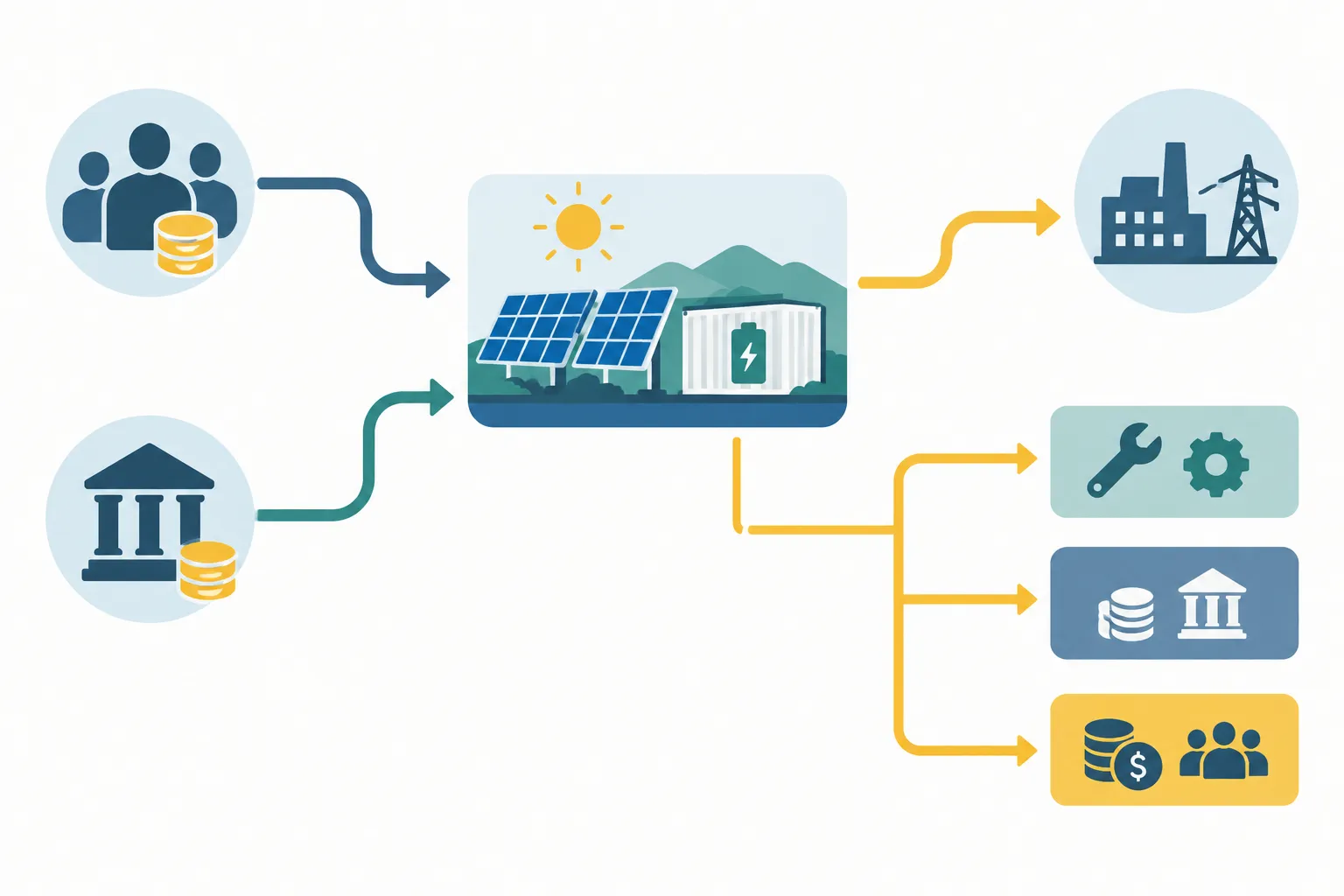
The sponsor develops site, permits, grid access, design, and revenue arrangements.
Equity investors and lenders commit capital to the SPV once agreed conditions are met.
The SPV pays for construction and begins commercial operation.
Revenue pays operating costs, required reserves, interest, and principal before cash is distributed to equity.
Battery storage and electrification assets can use the same structure. Their revenue contracts and allocation of risk may differ from those of a contracted renewable energy project. For any energy infrastructure asset, project sponsors must turn project development work into rights the SPV can rely on.
The capital stack changes as the project matures
Equity absorbs losses first and receives residual upside. Senior debt has contractual repayment and security rights, so lenders focus on whether forecast cash available for debt service will cover scheduled payments under stress. Other layers, such as subordinated debt, concessional funding, grants, or tax-related investment, depend on the asset, jurisdiction, and available programs.
For a closer look at capital instruments, see clean energy financing options and how tax equity differs from debt.
Funding layer | What it contributes | What the provider needs to see |
|---|---|---|
Sponsor or investor equity | Development spending, construction funding, and a cushion beneath debt | A credible path to completion and an acceptable return after debt service |
Construction debt | Drawn funding for eligible build costs | Budget, completion protections, equity contribution, and draw conditions |
Long-term senior debt | Term loans repaid from operating cash flow, sometimes replacing construction debt | Reliable revenue, operating assumptions, security, and coverage |
Other capital, where applicable | A way to bridge risk or fill a specific financing gap | Clear priority, eligibility, and compatibility with other investors' rights |
How much debt can a project support?
Consider a purely illustrative solar SPV with a build cost of 100 units: equity contributes 30 and construction lenders commit 70. This 30/70 equity/debt mix is an example, not a required ratio. If uncertain interconnection costs or merchant price exposure reduce forecast cash flow, the lender may offer less debt. The sponsor must bring more equity, cut costs, improve the revenue contract, or resolve the risk before borrowing more.
Sponsors or specialist development financing may fund early spending before banks and other financial institutions will provide loans for construction. At financial close, the parties sign financing documents and make funding available subject to agreed conditions. Construction draws and operating repayments follow separate milestones. Once the asset has an operating record, its owners may refinance on different terms.
Contracts that make projected revenue credible
Lenders need contracts to support the financial model's inputs. Each agreement should show who bears a material risk and what happens if a party fails to perform.
Power purchase agreement: who pays, how much, and when
A power purchase agreement (PPA) sets the terms on which a buyer purchases the project's electricity. Lenders read beyond the headline price: they examine delivery obligations, contract term, curtailment treatment, termination payments, and the buyer's ability to pay. The start date must also line up with construction. A signed PPA with a weak buyer or mismatched dates may support less debt than the developer expects.
Some projects have no fixed-price PPA. Merchant revenue moves with market prices; a battery may earn from several contracted and market-based services. Lenders stress those revenue assumptions and may size debt more conservatively. Enterprise buyers also need to understand the performance and price risks they take on under their procurement agreement.
EPC agreement: can the asset be delivered?
The engineering, procurement, and construction (EPC) agreement spells out the contractor's scope, price arrangements, schedule, testing, warranties, and remedies for delay or underperformance. Financiers compare it with the budget, insurance, equipment supply agreements, grid-connection timetable, and PPA start date. Broad exclusions and change-order rights can leave the SPV exposed to extra costs even under a fixed-price contract.
O&M agreement and other project rights
An operations and maintenance (O&M) agreement sets responsibilities for project operations after commissioning. Availability commitments, response times, monitoring, spares, and remedies help translate technical projections into a defensible operating-cost and output forecast.
Land tenure, permits, interconnection rights, insurance, and equipment warranties matter too. If a solar project lacks an executable grid connection or a secure site right, a signed PPA cannot by itself make the asset ready for construction finance.
What lenders and investors actually underwrite
Lenders want confidence in timely repayment; equity providers want enough return for the risks left after everyone else has been paid. Both need a traceable financial model, supported by documents rather than optimistic assumptions.
Risk | Underwriting question | Evidence or mitigation |
|---|---|---|
Development and permitting | Can the SPV legally build on the site? | Site rights, permits, environmental work, and a realistic approvals schedule |
Construction and technology | Can the asset reach completion within budget? | EPC scope, contingency, independent technical review, performance testing, warranties |
Grid and resource | Can it deliver the forecast energy or service? | Interconnection status, resource study, dispatch assumptions, curtailment analysis |
Revenue and counterparty | Will customers pay under enforceable terms? | PPA or other revenue contract, buyer credit analysis, downside price cases |
Operations | Will output and costs track the model? | O&M scope, maintenance budget, insurance, operating sensitivities |
Finance and policy | Can debt still be paid if conditions change? | Interest-rate and currency analysis where relevant, reserve accounts, policy and incentive diligence |
Lenders use the debt service coverage ratio (DSCR) to compare cash available for debt service with scheduled principal and interest over the same period. In a hypothetical year with 12 units available and 9 units due, DSCR is 12 ÷ 9 = 1.33. Lenders still examine when cash arrives, their required coverage, and what happens if generation falls, construction slips, costs rise, or prices decline.
If an uncertain grid date weakens the downside case, the sponsor needs to improve the interconnection position. Buyer credit may call for stronger credit support or a different offtake structure. Project readiness determines access to capital alongside investor appetite.
From early concept to financial close: a readiness sequence
Before approaching investors, separate a project's potential from the evidence available today.
Stage | What to assemble | What the next capital conversation can address |
|---|---|---|
Concept | Asset, location, sponsor, intended revenue model, preliminary cost and timeline | Whether the opportunity fits a mandate; typically still development risk |
Development | Site control, permits status, grid pathway, resource or demand work, draft contracts, cost basis | Which gaps block construction capital and which investor type can bear them |
Finance-ready | Diligence materials, negotiated commercial contracts, credible model and downside cases, defined capital ask | Debt sizing, equity terms, conditions precedent, and closing timetable |
Construction and operation | Draw evidence, completion tests, then actual performance and revenue data | Monitoring, covenant compliance, and potential refinancing |
A developer's capital request should state the project stage, funding amount and type, use of proceeds, remaining approvals, key counterparties, and open risks. Capital partners can then screen it against their mandate, geography, deal size, technology, and risk tolerance. For an enterprise, the first decision is whether to own the asset, buy its output, or finance a wider decarbonization program. Each choice calls for different contracts and obligations.
Further reading: finding climate project investors for developers and energy transition financing for corporates for enterprise teams.
Financial close requires legal documentation and diligence. Even after agreeing commitments, lenders can require particular documents, equity funding, security, and independent reports before allowing a draw.
Where Zero Circle fits
Zero Circle helps project owners see how their current readiness compares with what capital providers need. Its agentic project finance platform uses standardized project data and AI-driven fundability scoring, then matches projects with investors by mandate, geography, and deal size. Owners can focus outreach on relevant capital partners. Investors get pre-qualified deal flow and underwriting support, while enterprise teams can use the platform for financing strategy and capital structuring. The platform automates outreach, but a person reviews it; scores and drafts are explainable and reviewable.
The Zero Circle platform sets out its project-owner, capital-partner, and enterprise workflows.
The platform can surface gaps in land rights, interconnection, revenue contracts, and diligence before outreach begins. It cannot resolve those gaps on its own. Sponsors still need to address material risks and work with appropriate legal, technical, and financial advisers on the transaction.
The practical verdict
Energy project finance depends on contracts and cash flow that can support the capital stack under both expected and adverse conditions. Identify the missing evidence before choosing a leverage ratio. For a climate or energy project ready to approach capital providers, Zero Circle can help sharpen the structure, assess fundability, and match the deal with relevant investors.
FAQ
What is energy finance?
Energy finance is the funding of energy assets and activities. Energy project finance is one specific approach: capital is raised for a dedicated project company, with repayment based primarily on that project's cash flow.
What is project finance?
Project finance funds a specific asset through a dedicated entity whose contracts, assets, and expected cash flow support the investment. Debt is commonly non-recourse or limited-recourse to the sponsor, but lenders retain rights against the project and may negotiate specific sponsor commitments.
Which bank is best for project finance?
There is no single best bank for every project. The fit depends on the bank's mandate, technology and geographic appetite, deal size, construction-risk tolerance, and ability to work with the proposed capital stack. A ready diligence package makes those conversations more productive.